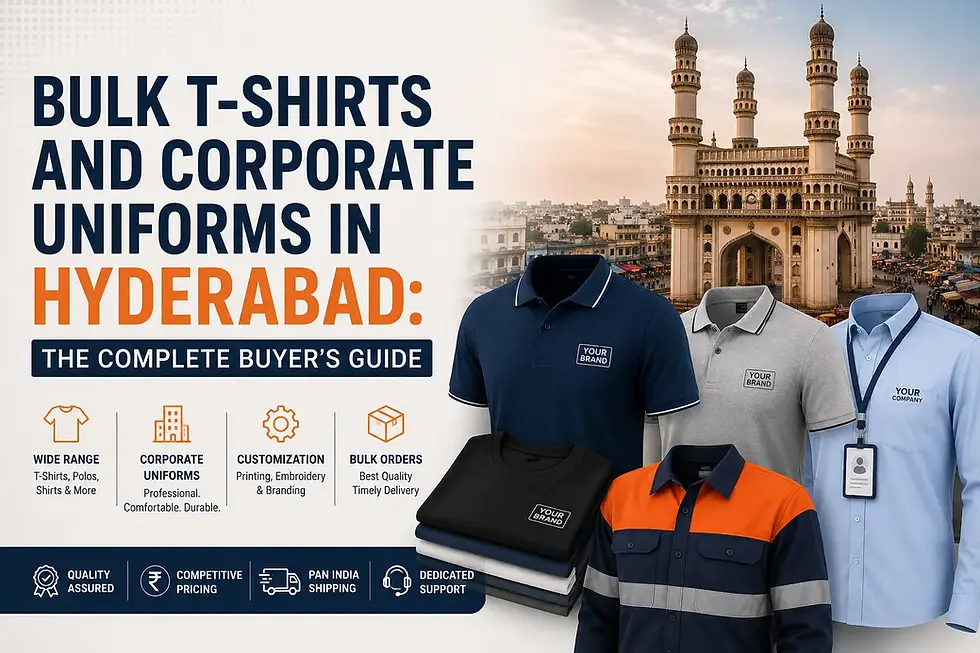
Bulk T-Shirts and Corporate Uniforms in Hyderabad: The Complete Buyer's Guide
- zooksteam
- 2 days ago
- 12 min read

If you've spent any time trying to source bulk t-shirts or uniforms in Hyderabad, you've probably noticed something odd: there's no real "garment district" to point to. Bengaluru has its export houses. Delhi has Gandhi Nagar. Tiruppur is basically a city built around knitwear. Hyderabad? It has HITEC City, Genome Valley, a booming film industry, and a lot of companies that need branded apparel — but not much of a manufacturing base to supply them.
That gap is exactly why this guide exists. Whether you're an HR manager in Gachibowli ordering 200 onboarding kits, a pharma company in Genome Valley needing GMP-compliant lab coats, or a startup founder trying to get 50 hoodies printed before a launch event, the sourcing playbook in Hyderabad looks different from what works in Mumbai or Bengaluru. Let's get into why, and what actually works.
Hyderabad's Sourcing Landscape: Why There's No Local Manufacturing Hub
Here's the thing most buyers figure out the hard way: Hyderabad is a garment consumption city, not a garment production city. The retail and wholesale action is concentrated around a handful of markets — Sultan Bazaar, Begum Bazaar, and pockets of Secunderabad — but these are largely trading and reselling hubs, not factories. Most of what moves through them is sourced from Tiruppur, Delhi, or Ahmedabad and simply re-sold with a local markup.
For a corporate buyer, that changes the math completely. You're not choosing between "local factory" and "outstation factory." You're choosing between:
A Hyderabad-based aggregator or trading company that takes your order, adds a margin, and outsources production somewhere else — often without telling you where.
A local printing shop that can handle small-batch DTF or screen printing on blank tees but doesn't manufacture the garments themselves.
Sourcing directly from an actual manufacturing hub — cutting out the local middleman entirely.
Most first-time bulk buyers in Hyderabad don't realize option one is even happening. They get a quote from a "Hyderabad supplier," assume it's a factory-direct price, and end up paying 15–25% more than they should — for the same garment, made in the same place, just routed through an extra layer.
This is where Agra comes into the conversation, and it's worth explaining why.
Why Agra Works as a Sourcing Base for Hyderabad Buyers
Agra isn't the first city that comes to mind for corporate apparel — most people associate it with the Taj Mahal, not t-shirts. But Agra has quietly built a strong manufacturing base for cotton garments, corporate wear, and bulk uniform production, backed by lower labor and operational costs than Tiruppur or the metro hubs. For a bulk buyer, that translates into a straightforward advantage: factory-direct pricing without the aggregator markup that's so common in Hyderabad's local market.
A few reasons this matters specifically for Hyderabad-based companies:
You skip the reseller layer. Instead of a Hyderabad vendor adding 15–20% to source from an actual factory, you go straight to the factory.
Lower base manufacturing costs. Agra's cotton garment ecosystem tends to run leaner than the big export hubs, and that saving shows up in your per-piece pricing on bulk orders.
Established bulk production capacity. Corporate and institutional uniform orders — the kind that need 500, 1,000, or 5,000 pieces in consistent quality — are exactly what Agra manufacturers are built for.
It's still domestic, still trackable. You're not dealing with import timelines or customs; it's a straightforward interstate shipment.
Zooks is one of the manufacturers operating out of Agra that Hyderabad companies — particularly IT firms and startups doing repeat merchandise orders — have started working with directly for exactly this reason. Cutting out the local aggregator layer and going factory-direct tends to be the single biggest lever for bringing bulk pricing down, and it's the approach we'd recommend to almost any Hyderabad buyer ordering in volume.
Understanding Hyderabad's Buyer Segments
Hyderabad's demand for bulk apparel isn't uniform — it comes from a handful of very distinct clusters, each with different priorities.
HITEC City and Gachibowli: The IT Corridor
This is Hyderabad's biggest source of bulk apparel demand, full stop. Between the global capability centers, product companies, and IT services firms packed into HITEC City and Gachibowli, there's constant demand for onboarding kits, team offsite tees, hackathon merchandise, and branded hoodies for internal events. The priorities here are speed, consistent quality across large headcounts, and designs that don't look like they were an afterthought. Most orders range from 100 to 2,000 pieces, often on tight turnaround because HR and admin teams tend to plan apparel two weeks before an event, not two months.
Genome Valley: Pharma and Life Sciences Uniforms
Genome Valley is home to a cluster of pharma, biotech, and life sciences companies, and their apparel needs are a different animal entirely. This isn't branded merchandise — it's functional workwear. Lab coats, scrub sets, and plant-floor uniforms need to meet specific fabric and hygiene standards, often GMP-compliant, with attention to stitching quality and washability under repeated industrial laundering. Buyers here care less about trendy prints and more about fabric GSM, colorfastness, and whether the supplier can maintain identical specs order after order.
Secunderabad: Government and Defence-Adjacent Procurement
Secunderabad's cantonment area and its proximity to defence establishments bring a steady stream of institutional and government-adjacent procurement — uniforms that need to follow strict specifications, tender documentation, and sometimes specific fabric compositions mandated by the procuring body. These orders move slower, involve more paperwork, and reward suppliers who can handle compliance requirements without cutting corners.
Banjara Hills: Premium Corporate Wear
Banjara Hills and Jubilee Hills are home to a lot of Hyderabad's premium corporate offices — law firms, consultancies, private banks, real estate majors. The apparel demand here skews toward polos, formal shirts, and premium blazers for client-facing staff, where fabric quality and finishing matter more than price per piece. It's a smaller volume segment but a higher-margin one, and buyers here are usually far less price-sensitive than they are quality-sensitive.
Tollywood and Film Production
Hyderabad's film industry — Ramoji Film City and the broader Tollywood ecosystem — generates a surprising amount of bulk apparel demand: crew t-shirts, production house merchandise, promotional tees for film launches. Turnaround is often the deciding factor here, since production schedules don't wait, and orders can spike suddenly around a shoot start date or a film's promotional cycle.
Startups: Branded Merchandise on a Budget
Hyderabad's startup scene, clustered around T-Hub and the broader Gachibowli-Madhapur belt, needs branded merchandise but rarely has the budget or lead time of a large IT company. These buyers want small-to-mid volume runs (50–300 pieces), competitive pricing, and flexibility — think investor-meeting swag, hackathon prizes, or a founding team's first batch of company tees. Price sensitivity here is real, which is exactly where cutting out a local aggregator markup makes the most difference.
Printing Methods Compared
Not every printing method suits every use case, and this is one area where Hyderabad buyers — especially first-timers — tend to over- or under-spec. Here's a practical breakdown.
Printing Method | Best For | Durability | Cost at Bulk | Turnaround |
Screen Printing | Large orders (300+), simple 1–3 color logos | Excellent — holds up through 50+ washes | Lowest per-piece cost at high volume | Longer setup time, but fast once running |
DTF (Direct-to-Film) | Small-to-mid orders, detailed or multi-color designs | Very good, slightly less durable than screen print over time | Higher per-piece cost, but no minimum order pressure | Fast setup, good for quick turnarounds |
Embroidery | Polos, corporate wear, premium finish | Excellent — essentially permanent | Higher cost, priced per stitch count | Moderate; digitizing the design takes time upfront |
Sublimation | Sportswear, all-over prints, polyester fabrics | Excellent on polyester; poor on cotton | Mid-range, fabric-dependent | Moderate |
Vinyl/Heat Transfer | Very small runs, one-off names/numbers | Weakest — cracks and peels over time | Low cost for small quantities | Fastest option available |
For most of Hyderabad's corporate and IT buyers ordering 200+ pieces, screen printing is the sweet spot on cost and durability. For premium corporate wear out of Banjara Hills, embroidery is worth the extra cost — it simply reads as more professional on a polo or blazer. Startups doing smaller, design-heavy runs are usually better off with DTF, since it doesn't punish you for low volume the way screen printing setup costs do.
Comparing Supplier Types
Since Hyderabad doesn't have a dominant local manufacturing base, your real choice comes down to what kind of supplier you're working with — and each type comes with real trade-offs.
Supplier Type | Pricing | Quality Control | Lead Time | Best For |
Local Hyderabad aggregator/trader | Marked up 15–25% over factory price | Inconsistent — depends entirely on their upstream vendor | Adds days for order relay | Very small, urgent, one-off orders |
Local printing shop (blanks + print only) | Moderate, but limited to what blanks they stock | Print quality can be good; garment quality is out of their control | Fast for print, but blank availability varies | Same-week small runs, single designs |
Direct factory sourcing (e.g., Agra-based manufacturers like Zooks) | Factory-direct, typically the lowest per-piece cost at volume | Consistent — you're dealing with the actual production line | 6–8 days transit from Agra, plus production time | Bulk corporate orders, repeat uniform contracts, cost-sensitive startups |
Large national B2B platforms | Competitive but platform fees baked in | Variable — quality depends on which factory fulfills your order | Depends on fulfillment partner | Buyers who want a single online checkout experience |
The honest takeaway: if your order is under 50 pieces and you need it in three days for an internal event, a local Hyderabad printing shop is genuinely your best bet — don't overthink it. But once you're ordering in the hundreds, and especially if it's a recurring uniform contract, going direct to a manufacturer cuts out a layer of cost that adds up fast across repeat orders.
Pre-Order Specification Checklist
Before you send an RFQ to any supplier — local or outstation — get these details locked down. This is the single biggest reason bulk orders go wrong: buyers assume the supplier will "figure it out," and then the delivered batch doesn't match what was in their head.
Fabric composition and GSM — 100% cotton, cotton-poly blend, or performance fabric? What GSM (grams per square meter)? 180 GSM feels very different from 220 GSM.
Size ratio breakdown — don't just say "200 pieces." Specify how many S/M/L/XL/XXL, based on your actual team's sizing, not a generic ratio.
Color and Pantone matching — if this is for a brand, get the exact Pantone code to your supplier, not just "navy blue."
Printing/embroidery method and placement — front chest, back, sleeve, left-chest logo — confirm placement and size in centimeters, not just "small logo on front."
Sample approval process — always request a physical sample or at least a digital mockup before full production starts. Never skip this on a first order.
Packaging requirements — individual poly-bagging, folded vs. hung, any special packaging for gifting or onboarding kits.
Delivery address and split shipments — one Hyderabad office or multiple locations (HITEC City + Genome Valley, for instance)?
Payment terms and advance percentage — standard is usually 50% advance, balance on dispatch, but confirm this upfront.
Lead time including buffer — ask for the realistic production timeline, then add a few days buffer for transit, especially on outstation orders.
Compliance requirements — for pharma or government-adjacent orders, confirm any GMP, fabric certification, or tender-specific documentation needed.
Run through this list before you request quotes, not after you've already committed to a supplier. It'll save you at least one frustrating round of "that's not what we ordered."
Agra to Hyderabad: What Delivery Actually Looks Like
For buyers considering an outstation supplier, the logistics question always comes up first: how long does it actually take? The distance from Agra to Hyderabad is roughly 1,600 km, and for bulk apparel shipments, that typically translates to a 6–8 day delivery window via standard road freight, once production is complete.
That's not overnight, obviously. But for corporate and institutional buyers — onboarding kits, uniform contracts, planned merchandise runs — this is a completely manageable timeline as long as it's factored into your ordering calendar. The mistake most buyers make isn't the transit time itself; it's not accounting for it. If you know you need 500 uniforms in-hand by the 1st of the month, backward-plan from an 8-day transit window plus production time, and place the order accordingly. Suppliers who work this route regularly, like Zooks, are used to planning shipments for Hyderabad-based corporate and institutional clients and can usually give you a realistic dispatch date upfront rather than a vague "2–3 weeks" estimate.
Frequently Asked Questions
1. Who is the best bulk t-shirt manufacturer for Hyderabad companies? There isn't a single "best" — it depends on volume and urgency. For large corporate or institutional orders, direct-from-factory manufacturers based in production hubs like Agra tend to offer better pricing and consistency than local Hyderabad aggregators, since you're not paying a reseller markup. For very small, urgent orders, a local printing shop is often more practical.
2. What's a reasonable minimum order quantity (MOQ) for corporate uniforms in Hyderabad? Most manufacturers set MOQs between 50 and 100 pieces for uniform-grade orders, though this varies by fabric and customization complexity. Some local printing shops will go lower, but usually at a higher per-piece cost.
3. How much does bulk t-shirt printing cost in Hyderabad? Pricing depends heavily on fabric, print method, and order size, but as a rough guide: screen-printed cotton tees at 300+ pieces typically run lower per-piece than small DTF orders under 100 pieces. Sourcing factory-direct rather than through a local trader is usually the biggest single factor in bringing the per-piece cost down.
4. Are there GMP-compliant uniform suppliers for pharma companies in Genome Valley? Yes — this is a specialized requirement, and it's worth explicitly asking any supplier for their compliance documentation and fabric certifications before placing a pharma or life-sciences uniform order, rather than assuming a general apparel supplier can meet the standard.
5. What's the difference between screen printing and DTF for bulk orders? Screen printing is more cost-effective at high volumes (300+) with simple designs and offers excellent wash durability. DTF is better suited to smaller orders or detailed, multi-color designs since it has no real minimum order penalty, though it's slightly less durable over the long run.
6. How long does bulk uniform production and delivery take for Hyderabad orders? Production timelines vary by order size and complexity, but for an outstation supplier based in a hub like Agra, budget roughly 6–8 days for transit alone, on top of production time. Planning your order 3–4 weeks ahead of when you need it in-hand is a safe rule of thumb for larger runs.
7. Can startups order small batches of branded merchandise in Hyderabad? Yes — most suppliers, including factory-direct manufacturers, offer smaller MOQs for startups, typically in the 50–100 piece range. DTF printing tends to work best for this segment since it doesn't require large volumes to be cost-efficient.
8. What uniform fabric works best for Hyderabad's climate? Hyderabad's warm, humid climate generally favors breathable cotton or cotton-poly blends in the 160–200 GSM range for daily-wear uniforms. Pure polyester tends to trap heat and is usually reserved for specific sportswear or sublimation-print use cases.
9. Do IT companies in HITEC City need to order through a local Hyderabad vendor? No — there's no requirement to source locally, and many HITEC City companies now order directly from manufacturers outside Hyderabad specifically to avoid the local aggregator markup, especially for recurring orders like onboarding kits.
10. What documents or approvals are needed for government or defence-adjacent uniform orders in Secunderabad? This depends on the specific tender or procuring body, but generally expect to need fabric composition certificates, sometimes GST and vendor registration documentation, and strict adherence to specified colors and fabric standards. It's worth confirming these requirements with the procuring department before finalizing a supplier.
Common Mistakes Hyderabad Buyers Make When Sourcing in Bulk
A few patterns show up again and again with first-time bulk buyers in Hyderabad, and most of them are avoidable.
Assuming "local" means "cheaper." It's an easy assumption to make — the vendor is five minutes from your office in Gachibowli, so surely they're cutting out shipping costs and passing on the savings? In practice, the opposite is usually true. A local vendor without their own factory is adding a margin on top of whatever they're paying an outstation manufacturer, and you're covering both their cut and the freight they already priced in.
Skipping the sample stage to save time. This is the one that comes back to bite people the most. Under deadline pressure, it's tempting to approve a design on screen and jump straight to full production. But screen color, fabric texture, and print placement almost never look exactly the way they do in a mockup. A two-day sample approval step is far cheaper than reprinting 500 pieces.
Not accounting for size ratio accuracy. Teams grow and change, and the size breakdown from your last order is rarely the right one for this order. Pull an actual headcount-by-size list before you place the order instead of reusing an old ratio or guessing.
Underestimating lead time for outstation orders. Six to eight days of transit sounds simple until it collides with a launch date that was set without factoring it in. Build the transit window into your planning calendar from day one, not as an afterthought once production is already underway.
Not asking who actually manufactures the garment. If you're working with any Hyderabad-based vendor, it's a fair and reasonable question to ask directly: is this being made in-house, or outsourced? A supplier who's transparent about their production source is usually more reliable than one who's vague about it — and it tells you immediately whether you're paying for an extra layer you don't need.
The Bottom Line
Hyderabad's apparel demand is real and growing — driven by its IT corridor, pharma cluster, film industry, and startup scene — but its local sourcing infrastructure hasn't caught up. That's not necessarily a problem; it just means the smart move is different here than it would be in a city with an established garment district. For most bulk and corporate buyers, going factory-direct to an established manufacturing base like Agra — working with a manufacturer like Zooks that already understands the logistics of shipping into Hyderabad — beats routing your order through a local aggregator that's just going to outsource it anyway, at a markup you're paying for.
Know your segment, get your specifications locked down before you request quotes, and plan your timeline around the real transit window instead of hoping it'll somehow arrive faster than it will. Do that, and bulk sourcing in Hyderabad stops being a guessing game.
Get a Free Quote from Zooks
🌐 zooks.in | 📞 +91 79063 40279 | 📩 zooksteam@gmail.com
WhatsApp us today and get a quote within 24 hour
— The Zooks Team
WhatsApp us today and get a quote within 24 hours