How to Plan Fabric Consumption for Bulk T Shirt Manufacturing

Fabric is often the largest material cost in a T-shirt order. A small error in consumption planning can lead to excess stock, delayed cutting, revised costing, or lower margins once production starts.
For clothing brands, apparel retailers, fashion startups, and procurement teams in India, fabric planning should happen before bulk T-shirt production is confirmed. It helps decide how much fabric to purchase, how to cost each garment, and how much wastage to allow without overbuying.
The key point is simple: actual consumption depends on the garment pattern, fabric width, size ratio, and cutting layout. Any number used before sampling is only an estimate until the final pattern and marker are approved.

What fabric consumption means in T-shirt manufacturing
Fabric consumption means the amount of fabric required to make one garment or a full order. In T-shirt production, this includes the fabric used for the front body, back body, sleeves, neck rib, collar, placket, pocket, and any other fabric components.
Consumption can be measured in different ways:
Kilograms per garment Common for knitted fabrics such as single jersey, pique, interlock, and rib.
Metres per garment Used when fabric is purchased or planned by length.
Total kilograms or metres for the order Used for procurement, dyeing, cutting, and production planning.
When planning fabric consumption for bulk T-shirt manufacturing, the goal is not to guess a universal figure. The goal is to build a practical estimate based on the approved garment design, fabric quality, width, GSM, size mix, and expected cutting efficiency.
The main factors that affect T-shirt fabric usage
Two T-shirts with the same chest size can require different fabric quantities if the pattern, fit, sleeve length, or fabric width changes. A reliable estimate starts with these variables.
T-shirt style changes the number of pattern pieces
A basic round-neck T-shirt usually has fewer pieces than a polo T-shirt. A polo may include a collar, placket, sleeve rib, pocket, and sometimes contrast trims.
Common style differences include:
Round-neck T-shirt
V-neck T-shirt
Raglan sleeve T-shirt
Oversized drop-shoulder T-shirt
Polo T-shirt with collar and placket
Cut-and-sew colour-blocked T-shirt
Hooded or long-sleeve T-shirt
More components often mean more fabric handling, more marker complexity, and more cutting loss.
GSM affects fabric weight and costing
GSM means grams per square metre. Higher GSM fabric weighs more for the same garment area.
For example, if two T-shirts have the same pattern but one uses 160 GSM fabric and the other uses 220 GSM fabric, the 220 GSM version will usually require more fabric weight per piece. That affects purchase quantity in kilograms and garment fabric costing.
GSM does not work alone. Fabric width, shrinkage, washing behaviour, and pattern area also affect the final requirement.
Garment size and fit change the pattern area
A size S regular-fit T-shirt needs less fabric than a size XXL oversized T-shirt because the pattern pieces are smaller.
Fit makes a major difference:
Regular fit Closer body measurements, standard sleeve and body length.
Relaxed fit Extra ease at chest, waist, shoulder, and sleeve.
Oversized fit Wider body, dropped shoulder, larger sleeves, and often longer length.
Even within the same nominal size, a streetwear oversized T-shirt may consume more fabric than a standard promotional T-shirt.
Fabric width affects marker planning
Knitted fabrics may come in different open widths or tubular forms. The usable width after relaxation, shrinkage, and edge trimming affects how many pattern pieces can fit across the fabric.
A wider fabric can sometimes improve marker efficiency, but only if the pattern pieces fit well within the layout. Narrower fabric may create more unused gaps, especially for larger sizes or oversized patterns.
Pattern dimensions decide the real consumption
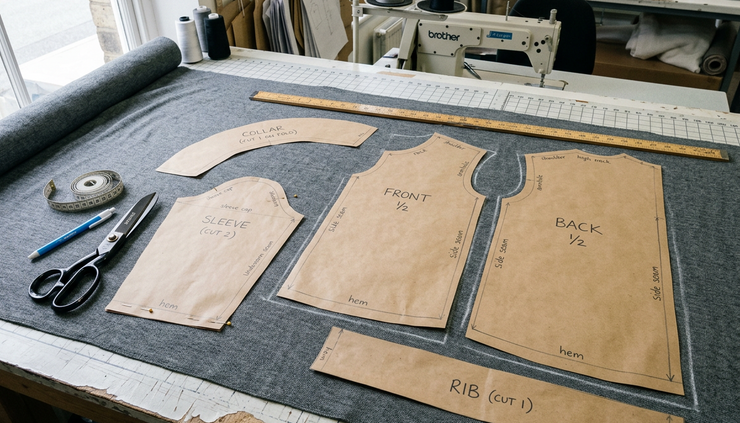
The final pattern is the most reliable base for fabric consumption per garment. Chest width, body length, shoulder drop, sleeve opening, sleeve length, neck shape, collar size, and rib placement all matter.
That is why buyers should avoid confirming bulk fabric quantities from only a tech pack sketch or reference sample. The manufacturer needs the actual pattern, fabric width, and size ratio to prepare a more reliable estimate.
How consumption varies by regular-fit, oversized, and polo T-shirts
Different T-shirt styles should not be planned with the same consumption assumption.
Regular-fit T-shirts usually have a simpler layout
A regular crew-neck T-shirt often has four main pieces: front, back, left sleeve, and right sleeve, plus neck rib. The pattern is predictable, and marker planning is usually more efficient.
This makes it easier to estimate, but the final number still depends on size, GSM, fabric width, shrinkage, and cutting layout.
Oversized T-shirts need more fabric area
Oversized T-shirts generally have wider bodies, broader shoulders, fuller sleeves, and sometimes longer lengths. Drop-shoulder construction can change how the sleeve and body pieces sit in the marker.
A brand selling oversized streetwear should not use a regular-fit T-shirt estimate. The difference can be material enough to affect order costing and profitability.
Polo T-shirts add fabric components
Polo styles use additional parts such as collars, plackets, collar stands, sleeve ribs, and pockets. Some collars are made from flat knit, while others use self-fabric or rib. Each option changes fabric planning.
If the polo uses contrast collar and cuff fabric, procurement also needs to split consumption by colour and material type. This makes the fabric requirement for bulk T-shirts more detailed than for a basic tee.
Plan the size ratio before estimating fabric
A bulk order rarely has the same quantity in every size. T-shirt size ratio planning helps calculate a weighted average consumption instead of using one size for the full order.
For example, a 1,000-piece order could be split like this:
Size | Quantity | Planning note |
S | 150 | Lower consumption per piece |
M | 250 | Often a high-volume size |
L | 300 | Often a high-volume size |
XL | 200 | Higher consumption than M and L |
XXL and above | 100 | Needs separate checking due to larger pattern area |
The right size ratio depends on the brand’s customer base, sales data, market segment, and fit. A college merchandise order may have a different size mix from a premium oversized streetwear drop.
Large sizes should never be treated as a minor detail. If XXL, 3XL, or 4XL quantities are high, the average consumption can rise noticeably.
A simple illustrative fabric consumption calculation
The table below shows a simplified example for planning purposes only. These are not universal industry standards. Your actual consumption will depend on the approved pattern, fabric width, GSM, marker, shrinkage, and cutting method.
Assume a brand is planning a 1,000-piece regular-fit round-neck T-shirt order in cotton single jersey. The manufacturer has prepared estimated consumption by size after checking the pattern and fabric width.
Size | Quantity | Illustrative estimated consumption per garment | Estimated fabric required |
S | 150 | 0.180 kg | 27.00 kg |
M | 250 | 0.200 kg | 50.00 kg |
L | 300 | 0.220 kg | 66.00 kg |
XL | 200 | 0.245 kg | 49.00 kg |
XXL | 100 | 0.275 kg | 27.50 kg |
Total before allowances | 1,000 | 219.50 kg |
In this example, the base fabric requirement is 219.50 kg before allowances.
Next, the production team adds allowances for shrinkage, cutting loss, fabric relaxation variation, end bits, shade segregation, and practical handling loss. The allowance should be agreed with the manufacturer based on the fabric type, dyeing process, style complexity, and past order experience.
A simplified planning format may look like this:
Planning stage | Quantity |
Base fabric requirement from size-wise consumption | 219.50 kg |
Add allowance for shrinkage, cutting loss, and expected wastage | Based on approved production plan |
Add contingency for safe procurement | Based on buyer and manufacturer agreement |
Final fabric to procure | Base requirement plus agreed allowances |
This is where a proper T-shirt fabric consumption calculation becomes useful. It separates pattern-based consumption from production allowances, so the buyer can see what is being planned and why.
Understand marker efficiency, fabric width, shrinkage, and wastage
Fabric planning is not only about garment measurements. Production realities matter.
Marker efficiency affects how much fabric is saved or wasted
A marker is the cutting layout that places all pattern pieces on the fabric. Marker efficiency shows how well the fabric area is used.
Better marker efficiency reduces fabric wastage in garment manufacturing. Poor marker efficiency creates more gaps between pattern pieces, especially when sizes are mixed badly or fabric width does not suit the pattern.
Marker efficiency can vary with:
Fabric width
Pattern shape
Size ratio
One-way or two-way cutting requirements
Stripe, check, placement print, or directional fabric
Whether fabric is tubular or open width
Cutting losses happen in normal production
Some fabric loss is normal during spreading and cutting. Loss may come from roll ends, edge trimming, layering defects, fabric holes, shade variation, and damaged sections.
Buyers should ask how the manufacturer identifies and records these losses. Good cutting-room control can reduce avoidable wastage.
Shrinkage must be checked before bulk cutting
Knitted fabric can shrink after washing, steaming, compacting, or garment finishing. If shrinkage is not checked before cutting, finished T-shirts may come out smaller than approved measurements.
Fabric testing should cover practical production needs, such as:
Dimensional stability
GSM after wash, where relevant
Colour fastness
Spirality in knitted fabric
Shade variation between rolls
Residual shrinkage after processing
A shrinkage test helps the pattern maker adjust the pattern before bulk cutting. It also helps the buyer approve realistic garment measurements.
How fabric cost affects final cost per T-shirt
Fabric cost has a direct effect on the final garment cost. If the fabric consumption per garment increases, the cost per T-shirt rises unless another cost element is reduced.
A simple costing logic looks like this:
Fabric cost per T-shirt = fabric consumption per garment × fabric rate
This is only the fabric component. The final price may also include trims, printing, embroidery, cutting, stitching, washing, finishing, packing, testing, transport, overheads, and margin.
For example, two designs using the same fabric rate can still have different garment costs if one has:
Higher GSM
Larger fit
More pattern pieces
Lower marker efficiency
Higher shrinkage allowance
Extra collar, rib, pocket, or placket fabric
Accurate garment fabric costing protects both sides. Buyers get clarity before placing the order, and manufacturers can purchase the right material without absorbing avoidable fabric shortages.
Why sample approval matters before bulk fabric planning
A sample is more than a visual approval. It confirms the construction, fit, measurements, fabric behaviour, and finishing process.
Before bulk cutting, the buyer and manufacturer should close these points:
Approved fit sample or pre-production sample
Final measurement chart with tolerance
Final fabric quality, GSM, width, and colour
Approved shrinkage and wash test results
Print, embroidery, label, and trim placement
Final size ratio and order quantity
Marker or consumption approval, where applicable
If any of these change after fabric is ordered, consumption may change too. A half-inch length increase across thousands of pieces can add fabric. A change from regular fit to relaxed fit can affect the full purchasing plan.
ZOOKS supports clothing brands and businesses with customised bulk apparel and T-shirt manufacturing solutions, including style development, sampling guidance, fabric planning, and production coordination. For buyers managing orders across India, this kind of production support helps reduce guesswork before committing to bulk.
Common fabric planning mistakes to avoid
Many wastage issues begin before the cutting room. They start with incomplete briefs, rushed estimates, or assumptions carried over from previous orders.
Common mistakes include:
Using one average consumption for all sizes
Treating oversized and regular-fit T-shirts the same
Ignoring fabric width while estimating quantity
Not checking shrinkage before bulk cutting
Changing the fit after fabric has been booked
Forgetting rib, collar, placket, or pocket consumption
Not separating body fabric and contrast fabric requirements
Planning from a reference garment without a production pattern
Ignoring shade variation between fabric rolls
Ordering fabric without confirming the final size ratio
The best way to reduce unnecessary wastage is to freeze the product details early. Confirm the pattern, fabric, size mix, and finishing process before placing the fabric order.
A practical checklist before confirming fabric quantity
Use this checklist before approving fabric procurement for a bulk T-shirt order.
Confirm the final T-shirt style and fit.
Approve the production pattern for all sizes.
Check the final size ratio for S, M, L, XL, XXL, and larger sizes.
Confirm fabric type, GSM, width, colour, and finish.
Ask whether the fabric is open width or tubular.
Review shrinkage and wash test results.
Confirm if the design needs one-way cutting, stripe matching, or print placement.
Include fabric for collars, ribs, plackets, pockets, and contrast panels.
Review the manufacturer’s marker-based consumption estimate.
Add agreed allowances for cutting loss, shrinkage, and practical wastage.
Confirm how roll variation and shade lots will be handled.
Keep a small approved contingency where the production plan justifies it.
Do not approve bulk cutting until the pre-production sample is signed off.
Plan fabric before you plan profit
Fabric planning is one of the most important steps in bulk T-shirt production because it connects design, production, purchasing, and pricing. A careful estimate helps prevent shortages, controls wastage, and gives a clearer view of order profitability.
The safest approach is to avoid fixed assumptions. Work from the final pattern, actual fabric width, confirmed size ratio, marker layout, shrinkage test, and approved sample.
For businesses looking for a clothing manufacturer India partners can work with for customised bulk apparel, ZOOKS can help plan and produce T-shirts for corporate, retail, promotional, and fashion requirements.
Discuss your bulk T-shirt requirements with ZOOKS to get practical guidance on fabric planning, sampling, and production for your next order.


