What GSM Should You Choose for Bulk T-Shirts? A No-Nonsense Buyer's Guide
- zooksteam
- Jul 2
- 6 min read

The number on the fabric label that most buyers ignore is actually the one that determines whether your bulk order feels premium or cheap.
By Team ZOOKS | July 2026 | ~2,000 words | 8 min read
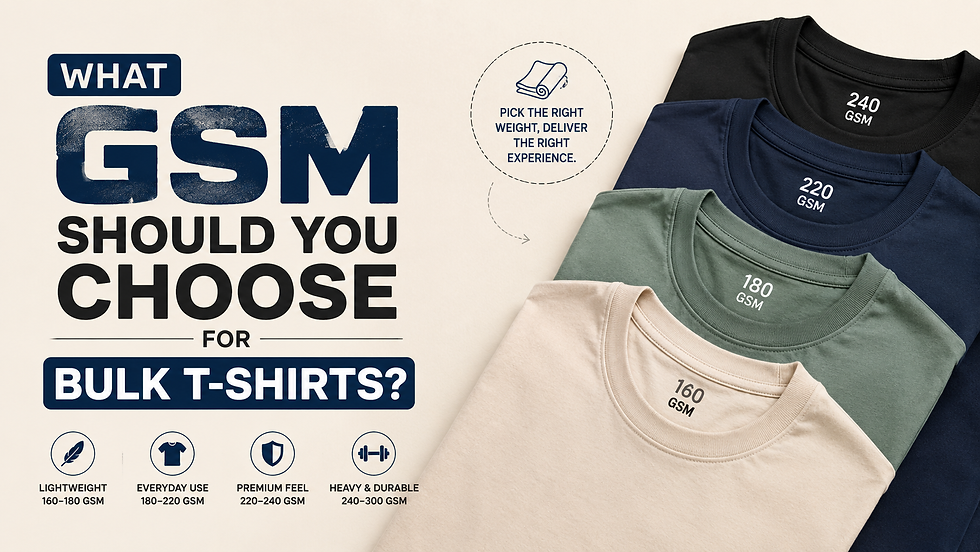
Every week, someone asks us: "What GSM should I go with?" And nine times out of ten, they've spent three hours comparing collar styles and two minutes thinking about fabric weight. That's backwards.
GSM stands for grams per square metre. It's the standard way the apparel industry measures how heavy or light a fabric is. And while it won't tell you everything about quality, it tells you more than colour, collar style, or cut when it comes to how a bulk order actually feels in someone's hands.
Get this number wrong and you end up with event tees that feel like paper or winter uniforms that aren't warm enough. Get it right and the fabric does half your brand-building for you before anyone even looks at the print.
Here's what the numbers actually mean, and how to pick the right one for your order.
First, What Does GSM Actually Tell You?
GSM measures the density of the fabric: how much material is packed into each square metre of the weave. Higher GSM means heavier, thicker, more substantial fabric. Lower GSM means lighter, thinner, more breathable fabric.
It doesn't directly tell you the cotton quality or the weave tightness. A 200 GSM bio-washed fabric will feel softer than a 200 GSM basic cotton, even though the weight is identical. But within the same fabric type, GSM is the fastest way to understand what you're getting before you order a single sample.
The practical range for bulk t-shirts in India runs from about 140 GSM on the light end to 280 GSM-plus for heavier pieces like hoodies and sweatshirts. Standard t-shirts generally sit between 160 and 260 GSM.
Breaking Down Each GSM Range
140 to 160 GSM: Very Light, Event-Grade Fabric
This is the lightest end of the range. These tees are thin, very breathable, and honestly feel a bit delicate when you hold them. The upside is cost: per-piece prices drop noticeably at this weight, which makes them popular for high-volume giveaway runs where budget matters more than longevity.
They work fine for a 5K run event or a single-day brand activation where the tee is a freebie, not a uniform. Don't use them for anything that needs to survive repeated washing. The print will outlast the shirt.
Best for: marathons, single-day events, large-volume giveaways, situations where you're printing 500-plus pieces and cost-per-piece is the primary constraint.
170 to 180 GSM: Light-Medium, the Summer Sweet Spot
This is where most budget-to-mid-range casual orders land. The fabric has some body to it without feeling heavy, which makes it good for the Indian summer climate, especially in North India where temperatures in Agra, Delhi, Lucknow, and Kanpur push well past 40 degrees from April onwards.
Startups ordering first-batch brand tees, student groups, and NGOs running awareness drives tend to land here. It's not premium, but it doesn't feel cheap either. Holds a screen print or DTF print well.
Best for: casual brand merchandise, startup giveaways, student groups, summer volunteer drives, mid-budget event tees.
200 to 220 GSM: Medium Weight, the Corporate Standard
This is the range where most corporate uniform orders, school shirts, and quality merchandise land. The fabric has enough weight to feel substantial, drapes well, and holds its shape after repeated washing. It's also the range where screen printing really shines: the ink has enough fabric density to bond properly and last.
If you're ordering uniforms for employees who'll wear them twice a week for a year, this is the floor. Going below 200 GSM for a daily-wear uniform is a false economy, because you'll be reordering sooner than you expect.
Best for: corporate uniforms, school and college t-shirts, year-round brand merchandise, sports club practice kits, anything worn regularly.
240 to 260 GSM: Substantial, Premium-Feel Orders
Pick up a 240 GSM t-shirt next to a 180 GSM one and you'll feel the difference immediately. This is the range where fabric starts to genuinely feel expensive to someone who doesn't know anything about GSM. Hotels, banks, and premium corporate clients often specify this weight for polo shirts and front-facing uniforms because it reads as quality before the logo even registers.
For bulk orders in this range, embroidery particularly works well. The fabric density supports the stitching without puckering, and the combination of heavy fabric and thread-based decoration gives you a product that looks like it cost more than it did.
Best for: premium corporate uniforms, customer-facing staff clothing, polo shirts, retail-quality blanks for clothing brands, Diwali and year-end gifting orders.
280 GSM and Above: Winter Weight, Hoodies and Sweatshirts
Above 280 GSM you're generally looking at fleece-lined hoodies, sweatshirts, and heavier pieces. This isn't standard t-shirt territory. North India winters are cold enough, particularly in Agra and UP, that these pieces have genuine functional demand from October through February.
Corporate gifting for Diwali and year-end often goes here: a well-made 300 GSM hoodie with a clean embroidered logo is a gift that actually gets used, which is why it tends to land better than the usual ceramic mug or desk calendar.
Best for: corporate winter gifting, college hoodies, sports club warmup jackets, year-end branded merchandise.
GSM Reference Table
GSM | Weight Feel | Durability | Best Season | Best Use Case |
140–160 GSM | Very light | Moderate | Summer only | Marathon tees, one-day events, giveaways |
170–180 GSM | Light-medium | Good | Summer/spring | Casual events, startups, student groups |
200–220 GSM | Medium | Very good | Year-round | Corporate uniforms, school shirts, brand merchandise |
240–260 GSM | Substantial | Excellent | Year-round/winter | Premium corporate, polos, retail-quality blanks |
280 GSM+ | Heavy | Premium | Winter/gifting | Hoodies, sweatshirts, high-end uniform pieces |
What Most Buyers Get Wrong
The most common mistake we see, particularly from first-time bulk buyers and small businesses, is treating GSM as a pure cost lever. They go lighter to save money per piece without factoring in that a 160 GSM shirt worn twice a week will start to look tired in three months, which means another order sooner than planned.
The second mistake is going too heavy for the wrong use case. A 260 GSM t-shirt being handed out at a summer event in Lucknow in June is going to make people uncomfortable. Weight and breathability work against each other, and forcing heavy fabric into a hot-weather context defeats the purpose.
And the third mistake: not requesting samples before committing to a bulk run. GSM numbers are useful shorthand, but fabric feel varies between mills, weaves, and cotton grades. A 200 GSM ring-spun cotton will feel noticeably different from a 200 GSM carded cotton, even though the weight is identical. Always feel the sample before you finalise.
A Quick Decision Guide
• Order for a summer event or giveaway, 200-plus pieces, cost is the main factor: 160 to 180 GSM.
• Year-round corporate uniform or school shirt, daily wear, needs to last: 200 to 220 GSM.
• Premium corporate polo, retail brand tee, or customer-facing uniform: 240 to 260 GSM.
• Winter gifting, hoodie, or sweatshirt: 280 GSM and above.
• Unsure: always request a sample at two or three weights and hold them side by side before deciding.
Frequently Asked Questions
Is higher GSM always better quality?
No. Higher GSM means heavier fabric, which is better for some use cases and wrong for others. A 160 GSM tee for a summer marathon is the right call. A 260 GSM tee for the same event would make runners miserable. Match the GSM to the actual use case.
What GSM is best for screen printing?
200 GSM and above. Thinner fabrics can bleed ink or distort under the press. At 200 GSM and up, the weave is dense enough to hold the ink cleanly and the curing works properly.
What GSM do most corporate uniform orders use?
Most corporate uniform orders we process sit between 200 and 240 GSM. Below 200 GSM and the fabric starts to look thin after a few months of regular wear. Above 240 GSM and the cost goes up without enough visible benefit for most everyday uniform applications.
Can the same GSM fabric feel different from different suppliers?
Yes, significantly. The cotton grade, the spinning method (ring-spun vs carded), the weave type, and the finishing process all affect how a fabric feels, even at an identical GSM. This is why samples matter and why GSM is a starting point, not the whole picture.
Does GSM affect print quality?
For screen printing, yes. For DTF, less so, since DTF transfers work across a wider range of fabric weights. Embroidery generally needs at least 200 GSM to support the stitching without the fabric puckering around the design.
The Bottom Line
GSM is the one number on a bulk apparel spec sheet that buyers consistently underestimate. It doesn't tell you everything, but it tells you more about how an order will feel, wear, and last than almost any other single variable.
Pick the weight for the job, not the weight that shaves the most off the per-piece cost. Request samples at two or three weights before you commit. And if you're placing a corporate or uniform order with the expectation that garments will be worn regularly, 200 GSM is the floor, not a premium upgrade.
We manufacture bulk apparel from our facility in Agra and ship pan-India, including Delhi NCR, Noida, Lucknow, Kanpur, and across Uttar Pradesh. If you're deciding between GSM options for your next order, our team will send you samples before you commit.
Get a Free Quote from Zooks
🌐 zooks.in | 📞 +91 79063 40279 | 📩 zooksteam@gmail.com
WhatsApp us today and get a quote within 24 hour
— The Zooks Team
WhatsApp us today and get a quote within 24 hour
www.zooks.in | zooksteam@gmail.com | Custom Bulk Apparel Manufacturer, Agra, India


