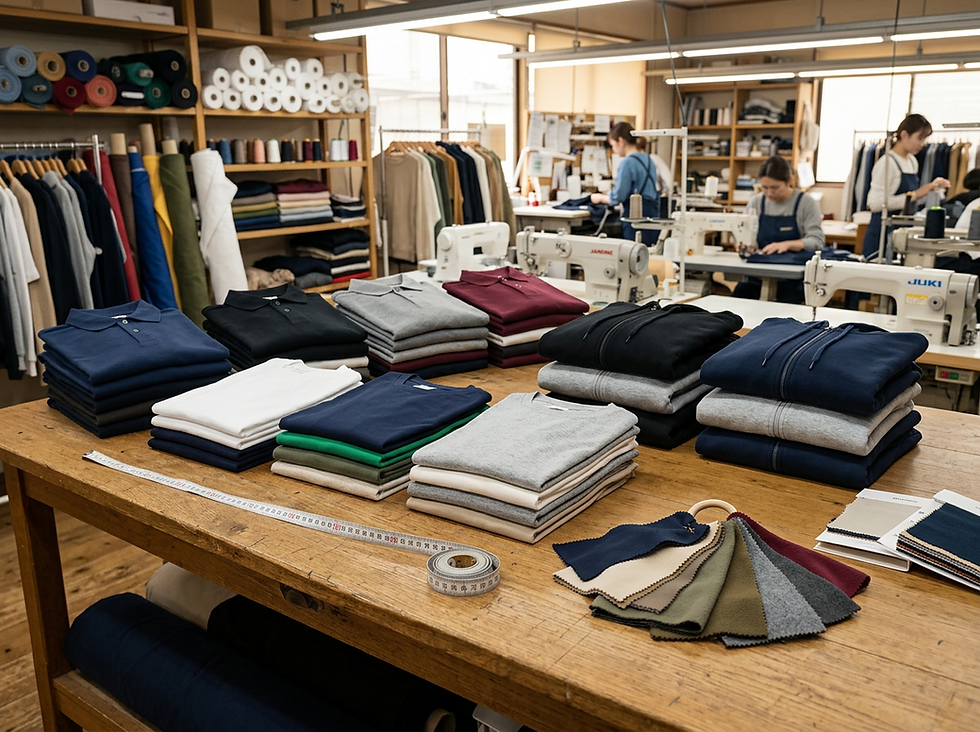
How to Order Custom Branded Apparel for 500 Employees

Ordering apparel for 500 or more employees is not the same as buying a small batch of event T-shirts. At this scale, small gaps in planning can create large problems: missing sizes, colour mismatch, delayed dispatches, uneven logo quality, or confusion across locations.
A successful bulk apparel order needs clear requirements, accurate employee data, approved samples, realistic timelines, and a supplier who can manage production at volume. This guide explains how HR, procurement, and administration teams can plan and execute custom branded apparel for employees without losing control over quality or coordination.

Start with clear apparel requirements
Before requesting quotations, define the purpose of the order. The use case affects product choice, fabric, branding method, packaging, and delivery schedule.
Common corporate requirements include:
New employee joining kits
Annual staff uniforms
Sales or field team apparel
Factory or backend team clothing
Dealer or channel partner merchandise
Event, offsite, or conference apparel
Department-wise teamwear
Winter wear for employees across regions
For 500+ employees, prepare a simple requirement brief. It should answer these questions:
What products are needed?
How many pieces are required in total?
Will every employee receive the same product?
Are there different products for different teams?
Is the apparel for daily use, occasional use, or gifting?
Are there multiple office, plant, warehouse, or branch locations?
What is the expected delivery date?
Is individual packaging required?
A clear brief helps manufacturers give accurate pricing and production timelines. It also reduces back-and-forth once production begins.
For example, a company may need 650 polo T-shirts for customer-facing staff, 300 hoodies for a winter campaign, and 120 jackets for regional managers. Combining these under one project helps with colour coordination, logo consistency, and dispatch planning.
Choose the right apparel products for the use case
For large employee groups, product selection should balance comfort, durability, brand presentation, and budget. Avoid choosing only by the lowest unit cost. Apparel that shrinks, fades, or feels uncomfortable can create more complaints than savings.
T-shirts work well for events and casual programmes
Round-neck T-shirts are suitable for internal events, onboarding kits, campaigns, and casual teamwear. They are usually easier to produce at scale and allow flexible printing options.
Use them when:
The order is time-sensitive
The design includes large printed artwork
The budget per person is moderate
The apparel is for activity-based use
Polo T-shirts are a strong choice for regular corporate wear
Polo T-shirts are often preferred for employee uniforms, retail staff, support teams, sales teams, and customer-facing roles. They offer a neat look without being too formal.
Use them when:
Employees will wear the product regularly
A collar is preferred
The logo should look clean and minimal
Embroidery is required
Hoodies and sweatshirts suit winter wear and employee gifting
Hoodies and sweatshirts work well for joining kits, team merchandise, tech teams, winter campaigns, and employee engagement programmes. They need more attention to GSM, fit, and branding placement because the garment is heavier.
Use them when:
The order is planned well before winter
The budget allows heavier fabric
The product should feel gift-worthy
Sizes may need more flexibility
Jackets need the most planning
Jackets are suitable for field teams, managers, logistics teams, outdoor staff, and premium gifting. They involve more decisions, such as lining, zipper quality, pockets, water resistance, and embroidery position.
Use them when:
The apparel will be used outdoors
Regional weather conditions matter
Durability is more important than low cost
The order has enough lead time for sampling
Product | Best suited for | Common branding method |
T-shirts | Events, campaigns, onboarding kits | Screen print, DTF, heat transfer |
Polo T-shirts | Staff uniforms, front-line teams | Embroidery, print |
Sweatshirts | Winter wear, internal merchandise | Print, embroidery |
Hoodies | Employee gifting, tech teams, offsites | Print, embroidery |
Jackets | Field teams, premium staff apparel | Embroidery, patches |
Finalise fabric, GSM, colours, and styles
Fabric selection plays a major role in comfort and product life. For corporate orders, the goal is not just to make the apparel look good on delivery day. It should also hold up after repeated use and washing.
Fabric
Common options include:
Cotton Comfortable and breathable, suitable for T-shirts and polos.
Cotton-poly blends More stable in shape, often preferred for uniforms and regular use.
Polyester or performance fabrics Useful for sports events, field teams, or high-movement roles.
Fleece or brushed fabric Used for sweatshirts and hoodies.
Softshell or quilted materials Used for jackets, depending on the purpose.
GSM
GSM means grams per square metre. It indicates fabric weight, though it should not be the only quality measure.
As a general guide:
Lightweight T-shirts may suit events or one-time campaigns.
Medium-weight fabric is better for regular corporate use.
Heavier GSM is common for winter wear, hoodies, and sweatshirts.
Ask the manufacturer to share fabric swatches or a physical sample. Two fabrics with the same GSM can still feel different because yarn quality, knitting, finishing, and construction also matter.
Colours
For bulk corporate apparel, choose colours that are:
Close to brand guidelines
Suitable for daily wear
Easy to reproduce across batches
Practical for the roles using them
If exact brand colour matching is required, provide Pantone references or approved colour codes. Keep in mind that fabric colour and print colour may appear different under natural light and indoor light.
Styles
For 500+ employees, simple styles are easier to manage. Too many style variations can complicate production and size planning.
Decide early on:
Regular fit or relaxed fit
Men’s, women’s, or unisex pattern
Collar type for polos
Sleeve length
Hood or no hood
Zipper or pullover style
Pocket requirements
Rib, cuff, and hem details

Collect employee sizes and prepare quantity breakdowns
Size data is one of the biggest risk areas in large apparel orders. Guesswork leads to shortages in common sizes and excess stock in slow-moving sizes.
Use a structured size collection process. HR or admin teams can collect sizes through an internal form with clear instructions.
Include:
Employee name or ID
Department
Location
Product type
Preferred size
Fit preference if relevant
Special size requirement if needed
Provide a size chart from the manufacturer before collecting responses. Do not use a generic size chart from another brand, because sizing varies across manufacturers and product types.
For a 500+ employee order, always prepare a size-wise quantity breakdown before quotation approval.
Example format:
Size | T-shirts | Polos | Hoodies | Jackets |
XS | 20 | 10 | 8 | 5 |
S | 80 | 65 | 50 | 30 |
M | 180 | 160 | 120 | 70 |
L | 170 | 180 | 140 | 75 |
XL | 90 | 110 | 80 | 45 |
XXL | 35 | 45 | 30 | 20 |
3XL | 10 | 15 | 8 | 5 |
Build a small buffer into your order, especially for common sizes and new joiners. The right buffer depends on internal hiring plans, past size trends, and product type.
Plan logo placement and branding methods
Branding should look consistent across all units, sizes, and product types. A logo that looks balanced on an L-size polo may look too large on an XS and too small on a 3XL if not planned correctly.
Common logo placements
Typical placements include:
Left chest
Centre chest
Back
Sleeve
Cuff
Hood
Jacket pocket area
Inside neck label
Hang tag or packaging sticker
Try not to overload the garment. For employee apparel, clean branding often works better than large, loud artwork.
Printing and embroidery options
The right method depends on fabric, design size, budget, and expected use.
Method | Works best for | Watch out for |
Screen printing | Large quantities, simple colours | Set-up time and colour limitations |
DTF printing | Detailed artwork, smaller design runs | Hand feel and wash durability should be checked |
Heat transfer | Names, numbers, short runs | Not ideal for every fabric |
Embroidery | Polo T-shirts, jackets, premium apparel | Fine details may not reproduce well |
Patches | Jackets, hoodies, premium merchandise | Adds cost and production steps |
For embroidery, simplify small text and fine graphic elements. For printing, confirm the artwork file quality. Vector files are preferred for logos because they scale cleanly.
Approve samples before bulk production
Never move directly into production for a 500+ piece order without sample approval. A sample helps confirm the product, fit, colour, fabric, logo size, logo placement, and finishing.
A good sample approval process includes:
Fabric and GSM approval
Fit and size approval
Colour approval
Branding placement approval
Print or embroidery quality approval
Wash or basic handling check if needed
Packaging style approval
Once approved, document the sample details. Share photos, measurements, artwork placement files, and written approval with all internal stakeholders.
For large orders, the approved sample becomes the reference point for production and quality control. If the sample had a 7 cm embroidered logo on the left chest, production should not shift to a different size or placement unless formally approved.

Understand MOQ, bulk pricing, and budgeting
MOQ means minimum order quantity. It can apply to garment style, colour, fabric, branding method, or size mix. In bulk apparel manufacturing, MOQ is not just about total order quantity. A supplier may be able to produce 800 polo T-shirts, but not in eight different colours with very small quantities in each colour.
Pricing usually depends on:
Product type
Fabric type and GSM
Order quantity
Number of colours and styles
Branding method
Number of branding positions
Size range
Packaging requirements
Delivery locations
Urgency of timeline
When preparing budgets, look beyond the base garment cost. Include sampling, branding, extra packaging, transport, GST, and any location-wise dispatch costs.
Ask for a clear quote that separates major cost heads. This makes internal approvals easier and reduces confusion later.
ZOOKS, a bulk custom apparel manufacturer in India, can support large corporate orders where product selection, branding, production, packing, and dispatch need to be handled as one coordinated project.
Build a realistic production and delivery timeline
Large apparel orders need enough time for approvals and manufacturing. Rushing every stage increases the risk of mistakes.
A typical project flow may include:
Requirement sharing
Product and fabric selection
Quotation and budget approval
Artwork and size chart finalisation
Sample development
Sample review and changes
Bulk production
Branding
Quality checking
10. Packaging
11. Dispatch and delivery
The total timeline depends on product type, quantity, fabric availability, branding method, and delivery locations. T-shirts may move faster than jackets. Embroidery may need more time than a simple print. Multiple colours and styles can also add complexity.
Set internal approval deadlines. Many delays happen because samples, artwork, or budgets sit pending with multiple stakeholders.
Control quality across large quantities
Quality control becomes more important as quantity increases. A minor issue repeated across 700 garments becomes a major problem.
Inspect at different stages rather than only at the end.
Key checks include:
Fabric colour and feel
GSM and fabric consistency
Stitching strength
Collar, cuff, rib, and zipper quality
Measurement consistency
Logo placement
Print or embroidery finish
Loose threads and stains
Shade variation between batches
Packaging accuracy
Size label accuracy
For large orders, inspection should include random checks across sizes, cartons, and production lots. If products are going to separate locations, carton labelling should also be checked before dispatch.
Plan packaging and delivery early
Packaging is often treated as a final step, but it affects distribution, employee experience, and delivery accuracy.
Individual packaging
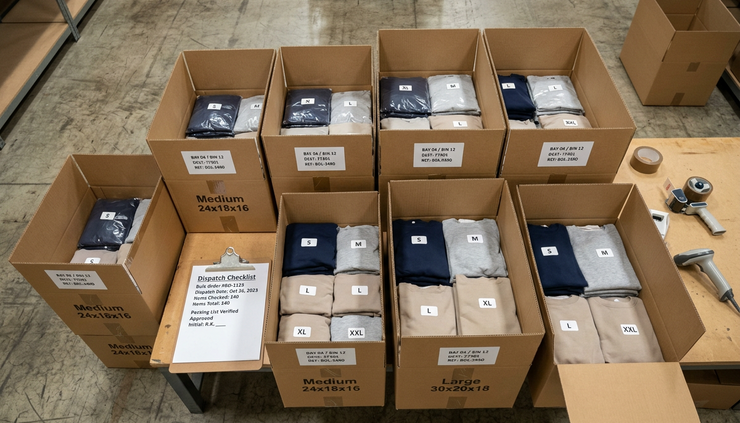
Individual packaging works well when apparel will be handed directly to employees. Each pack can include a size label, employee name, department, or location code.
Use it for:
Joining kits
Department-wise distribution
Multi-location dispatches
Premium corporate gifting
Large internal events
Department-wise packaging
Department-wise packing is useful when HR or admin teams will distribute apparel internally. Cartons can be labelled by department, product, size, and quantity.
Example carton label details:
Company name
Location
Department
Product type
Size range
Quantity
Carton number
Multi-location deliveries
For companies with offices, factories, retail stores, warehouses, or branches across India, prepare a location-wise dispatch plan.
Include:
Complete delivery address
Contact person
Contact number
Products assigned to the location
Size-wise quantity
Packaging type
Required delivery date
Courier or transport preference if any
Share the dispatch list before packing begins. Last-minute location changes can lead to wrong shipments and delays.
Avoid common mistakes in large apparel orders
Large orders usually go wrong because of planning gaps, unclear approvals, or late changes.
Avoid these mistakes:
Starting without a confirmed size chart
Collecting employee sizes too late
Approving production without a physical sample
Choosing too many colours or styles in small quantities
Using low-resolution logo files
Ignoring branding limitations on fabric
Changing artwork after production starts
Not budgeting for packaging and delivery
Skipping buffer quantities for key sizes
Assuming all locations need the same size mix
Leaving dispatch planning until the final week
Not documenting approved sample details
A simple rule helps: finalise decisions before bulk production starts. Changes after that point usually affect cost, timelines, or consistency.
Checklist for HR and procurement teams
Use this checklist before placing a 500+ employee apparel order.
Requirement planning
Confirm product types and total quantity
Define purpose and usage
Decide employee, department, and location coverage
Set target delivery date
Confirm budget range
Product and fabric
Shortlist T-shirts, polos, hoodies, sweatshirts, or jackets
Approve fabric type
Confirm GSM range
Select colours
Finalise fit and style
Sizing
Share manufacturer size chart internally
Collect employee size data
Prepare size-wise quantity breakup
Add buffer quantities where needed
Confirm special size needs
Branding
Share vector logo files
Confirm logo placement
Choose print, embroidery, patch, or transfer
Approve artwork size and position
Check branding quality on sample
Production
Confirm MOQ and pricing
Approve final quotation
Approve physical sample
Lock production timeline
Track milestones
Quality and delivery
Define quality checks
Confirm packaging format
Prepare department-wise or location-wise packing list
Share dispatch addresses
Check carton labels before shipping
For large-volume corporate apparel enquiries, speak with ZOOKS about product options, sampling, bulk production, branding, packaging, and nationwide delivery support across India.
A 500+ employee apparel order works best when it is treated as a coordinated project, not a last-minute purchase. Start with accurate requirements, keep decisions documented, approve samples carefully, and plan dispatch before production ends. That is how companies maintain consistent quality while making distribution easier for HR, procurement, and admin teams.