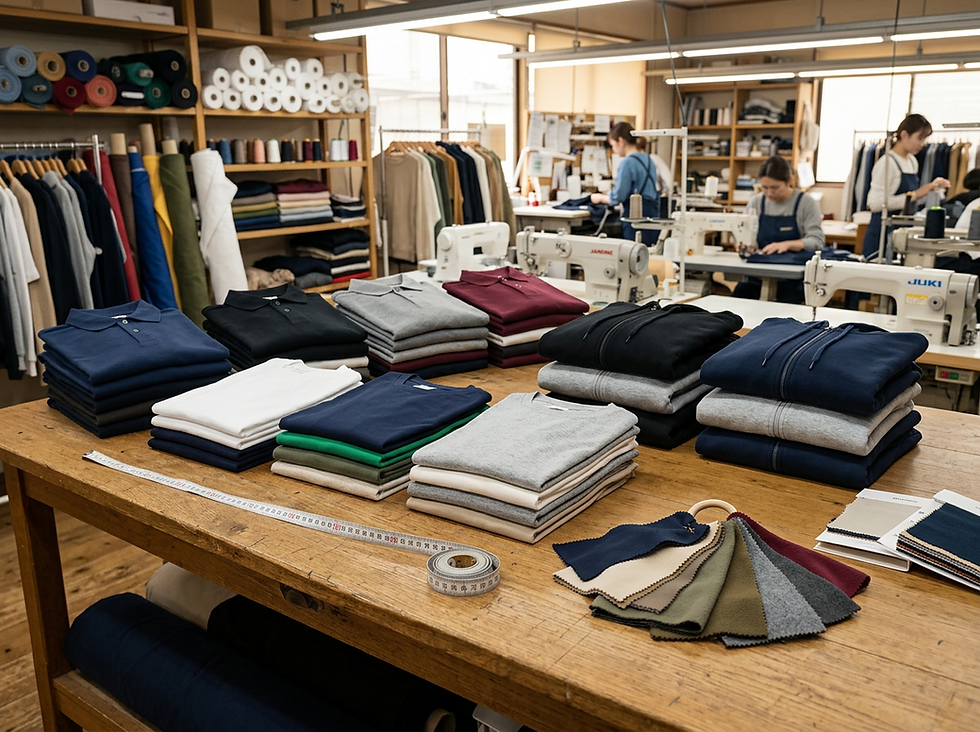
What Information to Send a Clothing Manufacturer for an Accurate Quote

A clothing manufacturer can only quote accurately when the request is specific. If the enquiry says, “Need 500 T-shirts, please share price,” the manufacturer has to guess the fabric, fit, printing method, sizing, packaging, delivery terms, and quality level. That usually leads to a rough estimate, not a usable quote.
For bulk apparel orders, small details can change the cost. A 220 GSM bio-washed cotton T-shirt with embroidery, neck tape, custom labels, and individual polybags will not cost the same as a basic 160 GSM promotional T-shirt with a single-colour print.
The right information helps the manufacturer understand the work, price it correctly, and flag any issues early. It also helps buyers compare suppliers more fairly, because each manufacturer is quoting against the same specifications.

Start with the product type and garment style
The first detail to share is what product needs to be made. The manufacturer needs to know the category, construction, and intended use before pricing.
Examples include:
Crew neck T-shirts
Polo T-shirts
Hoodies and sweatshirts
Shirts
Trousers and joggers
Uniforms
Jackets
Workwear
Kidswear
Sportswear
Promotional apparel
Retail-ready fashion garments
Be specific about the style. “Polo T-shirt” is a category, but the final cost depends on the details.
Share details such as:
Fit Regular fit, slim fit, oversized, relaxed, boxy, or performance fit
Neckline or collar type Crew neck, V-neck, polo collar, mandarin collar, rib collar, woven collar, or zipper neck
Sleeve style Half sleeve, full sleeve, raglan sleeve, drop shoulder, or sleeveless
Construction details Side seams, tubular body, ribbed cuffs, pockets, plackets, panels, drawstrings, zippers, or linings
End use Retail product, staff uniform, event merchandise, school uniform, corporate gifting, or industrial workwear
End use matters because it affects fabric choice, finishing, quality checks, and packing. A retail hoodie may need premium finishing and size stickers. A factory uniform may need durability, easy washing, and colour consistency across repeat orders.
Share quantity, MOQ, sizes, and colour breakdown
Quantity is one of the biggest pricing factors in apparel manufacturing. Most manufacturers have a minimum order quantity, often called MOQ, because fabric sourcing, dyeing, cutting, trims, printing screens, embroidery setup, and production line planning require a minimum volume to be practical.
When asking for a quote, do not only mention the total quantity. Share how that quantity splits across styles, colours, and sizes.
A clearer request looks like this:
Detail | Example |
Product | Polo T-shirt |
Total quantity | 1,000 pieces |
Colours | Navy, white, black |
Size range | S to 3XL |
Order split | 400 navy, 300 white, 300 black |
Size split | S 10%, M 25%, L 30%, XL 20%, 2XL 10%, 3XL 5% |
This helps the manufacturer calculate fabric consumption, dyeing or fabric purchase, cutting efficiency, and wastage.
If the size range includes plus sizes, tall fits, kids’ sizes, or mixed men’s and women’s fits, mention that upfront. Larger sizes often need more fabric. Separate patterns may also be needed for different fits.
Also ask about MOQ at three levels:
Style MOQ Minimum quantity per garment style
Colour MOQ Minimum quantity per colour
Size MOQ Minimum quantity per size, if applicable
For example, a manufacturer may accept 1,000 pieces total, but may not accept 50 pieces in ten different colours because fabric and dyeing minimums may not support it.

Explain fabric, GSM, colour, and finish requirements
Fabric details can make or break a quotation. A manufacturer cannot price properly without knowing what material is required.
Share the fabric type as clearly as possible. Common examples include:
100% cotton single jersey
Cotton-polyester blend
Polyester dry-fit
French terry
Fleece
Pique knit
Poplin
Twill
Denim
Rayon
Linen blend
Recycled polyester, if required
Next, mention the GSM, which stands for grams per square metre. GSM indicates fabric weight. For example, a lightweight promotional T-shirt may use a lower GSM, while a premium oversized T-shirt may use a heavier GSM.
If GSM is not final, give a range or share the intended feel:
Lightweight and breathable
Mid-weight for daily wear
Heavyweight premium feel
Soft brushed fleece
Structured woven finish
Stretchable performance fabric
Also include colour requirements. If colour matching is important, share:
Pantone code, if available
Existing fabric swatch
Reference garment
Brand colour guide
Lab dip approval requirement
Finish details are also important. These can affect both price and lead time.
Examples include:
Bio wash
Silicon wash
Enzyme wash
Peach finish
Anti-pilling finish
Brushing
Pre-shrinking
Moisture-wicking finish
Water-repellent finish
If the product must meet specific shrinkage, colour fastness, or wash durability expectations, include those in the enquiry. For uniforms and repeat retail orders, consistency across batches is often as important as the first delivery.
Provide artwork, logos, labels, and packaging details
Customisation is a major cost driver. Printing and embroidery are not priced only by size. The number of colours, placement, stitch count, technique, and setup requirements all affect the quote.
For logo and artwork requirements, share:
Artwork file Vector files such as AI, EPS, PDF, or high-resolution artwork are preferred
Placement Left chest, centre chest, back, sleeve, collar, hem, pocket, or multiple positions
Artwork size Mention width and height in cm
Technique Screen print, digital print, heat transfer, sublimation, embroidery, appliqué, patch, or woven badge
Number of colours Especially important for screen printing and embroidery
Special effects Puff print, reflective print, metallic print, high-density print, or textured embroidery
For embroidery, stitch count affects cost. If the exact stitch count is not available, share the logo file and desired size so the manufacturer can estimate.
Branding details should also be included. These may seem small, but they influence sourcing, production steps, and packing time.
Mention whether you need:
Main neck labels
Size labels
Wash care labels
Woven labels
Printed neck labels
Hang tags
Barcode stickers
Price tags
SKU stickers
Individual polybags
Recycled or paper packaging
Carton labelling
Assortment packing by branch, store, department, or employee name
For corporate and uniform orders, packing instructions can be just as important as the garment. For example, an order may need to be packed employee-wise with name, size, and department details. That takes extra handling and should be priced before production starts.

Send tech packs, sketches, reference images, or samples
The best quotation requests include a tech pack. A tech pack is a document that explains how the garment should be made. It gives the manufacturer a clear production reference and reduces guesswork.
A practical tech pack may include:
Flat sketches
Measurement chart
Size grading
Fabric specifications
Trim details
Stitching details
Artwork placement
Label placement
Packaging instructions
Colour references
Quality standards
Sample photos or reference images
If you do not have a full tech pack, send what you have. A sketch, reference garment photo, or physical sample can still help. Be clear about whether the reference is for fit, fabric, colour, print placement, or overall look.
For example, do not send a photo of a hoodie and say, “Need like this.” Instead, mention:
Similar silhouette and fit
Different fabric required
Logo on left chest
No kangaroo pocket
Rib cuffs and hem required
Drawcord colour to match body fabric
If a sample is needed before bulk production, say so in the quote request. Ask whether the sample is paid, how long it will take, and whether sample cost can be adjusted against the bulk order.
Mention delivery location, timeline, quality, and custom requirements
A manufacturing quote is not complete without delivery details. The same garment can have different landed costs depending on where it needs to be shipped and how quickly it is required.
Share:
Delivery city and state
Delivery to one location or multiple locations
Domestic dispatch or export shipment
Required delivery date
Preferred mode of transport, if any
Whether the quote should include freight
For India-focused orders, mention whether delivery is required to a warehouse, retail store, event venue, institution, factory, or multiple branches. If the order is time-sensitive, share both the expected delivery date and the date by which approvals will be completed.
Quality requirements should also be clear. Different buyers expect different levels of inspection and documentation.
You can mention:
Acceptable measurement tolerance
Fabric shrinkage expectations
Colour fastness requirements
Stitching standards
Wash test requirements
Needle detection requirement, if relevant
AQL inspection requirement, if used
Need for pre-production sample approval
Need for size set approval
Need for lab testing or certification
If the apparel is for uniforms, industrial use, schools, hospitality, healthcare, retail staff, or sports teams, share any practical performance needs. This may include stretch, durability, comfort in warm weather, opacity, easy ironing, stain resistance, or repeated wash performance.
This is also where custom apparel manufacturers like ZOOKS can help buyers refine the requirements before production. For bulk and custom orders, sharing complete specifications early allows the team to suggest suitable fabrics, branding methods, and production options before the quote is finalised.
A good quote request does not need to be complicated. It needs to remove assumptions.
Ask the right questions before accepting a quote
The lowest quote is not always the best quote. Before accepting, check what is included, what is excluded, and what assumptions the manufacturer has made.
Ask these questions:
What exactly is included in the quoted price?
Does the price include fabric, trims, labels, printing, embroidery, packing, and GST?
Is freight included or charged separately?
What is the MOQ per style, colour, and size?
What fabric GSM and composition has been quoted?
Is the price based on available fabric or custom-dyed fabric?
Is sampling included?
What is the sample timeline and bulk production timeline?
What approvals are needed before production starts?
What are the payment terms?
What happens if there is a size, colour, or quality issue?
Can the same price be maintained for repeat orders?
How long is the quote valid?
Also ask whether the manufacturer has quoted based on your exact specifications or suggested alternatives. Sometimes alternatives are useful, but they should be clearly marked.
Avoid mistakes that lead to inaccurate quotations
Most inaccurate apparel quotes come from missing or unclear information. The manufacturer fills the gaps with assumptions, and those assumptions may not match what the buyer expects.
Common mistakes include:
Asking for a price with only a product name
Giving total quantity without colour and size breakup
Saying “premium fabric” without fabric composition or GSM
Sending low-quality logo images instead of usable artwork
Not mentioning print or embroidery size
Forgetting labels, tags, and packaging
Not sharing delivery location
Asking for urgent delivery after the quote is approved
Comparing quotes where each supplier has assumed a different fabric
Changing specifications after receiving the price
A simple example shows why this matters. If three manufacturers quote for “1,000 black T-shirts,” one may assume 160 GSM cotton, another may quote 180 GSM cotton-poly, and a third may include 220 GSM combed cotton with bio wash. The prices cannot be compared fairly because the products are not the same.
This is why the best information to send apparel manufacturer for quote includes product, fabric, quantity, customisation, packaging, delivery, and quality details in one place.

Apparel Quote Request Checklist
Use this checklist before contacting a manufacturer for a bulk or custom apparel quote.
Requirement | Details to prepare |
Product type | T-shirt, polo, hoodie, uniform, shirt, jacket, workwear, or other garment |
Garment style | Fit, sleeves, collar, pockets, placket, cuffs, panels, trims, closure type |
Quantity | Total order quantity and expected repeat order quantity, if any |
MOQ expectations | Required quantity per style, colour, and size |
Fabric | Composition, knit or woven type, GSM, stretch, feel, and performance needs |
Colour | Pantone code, swatch, reference image, or shade requirement |
Finish | Bio wash, silicon wash, brushed finish, anti-pilling, moisture-wicking, or other finish |
Size range | XS to 5XL, kids’ sizes, men’s or women’s fit, plus sizes, or custom sizes |
Quantity breakup | Quantity by colour and size |
Artwork | Logo files, print files, embroidery files, artwork size, and placement |
Decoration method | Screen print, digital print, sublimation, embroidery, patch, transfer, or woven badge |
Labels | Main label, size label, wash care label, printed neck label, or woven label |
Tags | Hang tag, barcode, price tag, SKU sticker, or carton label |
Packaging | Individual packing, bulk packing, store-wise packing, employee-wise packing, or eco-friendly packing |
Tech pack | Sketches, measurement chart, grading, reference photos, sample notes, or physical sample |
Quality requirements | Measurement tolerance, wash performance, colour fastness, inspection level, sample approvals |
Delivery | City, state, number of delivery points, freight inclusion, and dispatch preference |
Timeline | Sample deadline, approval date, bulk delivery date, and event or launch date |
Commercial details | GST, payment terms, quote validity, sampling cost, and repeat order pricing |
Complete specifications make price comparison easier
A detailed quote request saves time for both sides. It also makes supplier comparison more transparent.
When every manufacturer receives the same specifications, the buyer can compare:
Fabric quality
GSM and composition
Customisation method
Packaging inclusions
Sampling process
Lead time
Freight and taxes
Payment terms
Quality checks
Total landed cost
This reduces the risk of choosing a supplier based only on a low headline price. It also helps procurement teams document why one quote is higher or lower than another.
For retailers, startups, corporate buyers, and bulk apparel purchasers, this clarity is especially useful when multiple decision-makers are involved. A complete specification sheet becomes a shared reference for sourcing, finance, design, and operations.
If you are preparing a bulk or custom apparel order, send your garment details, quantity breakup, artwork, delivery requirements, and quality expectations to ZOOKS for an accurate manufacturing quotation. A clear enquiry helps the team respond with practical pricing, suitable production options, and the next steps for sampling or bulk production.
The main takeaway is simple. The more complete the brief, the more reliable the quote. A manufacturer should not have to guess the garment. A buyer should not have to compare unclear prices. Complete specifications help both sides start the order on solid ground.