Private Label Apparel Manufacturing in India
- zooksteam
- Jul 6
- 7 min read

What It Is and How It Works
By Team ZOOKS | 2026 | ~2,000 words | 9 min read
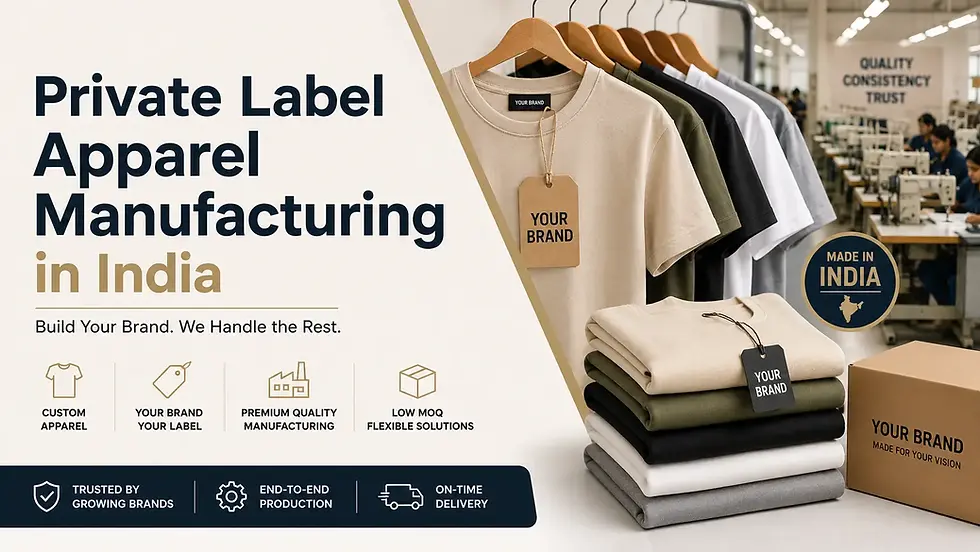
You've got a brand idea. Maybe it's a streetwear line, a fitness apparel brand, or a corporate gifting business you're building on the side. You know what you want your customers to feel when they open the package. What you probably don't know yet is how the actual garment gets made, labeled, and shipped with your name on it instead of a factory's.
That's where private label apparel manufacturing comes in, and it's quietly become the fastest route for Indian entrepreneurs to launch a clothing brand without owning a single sewing machine.
This guide breaks down what private label manufacturing actually means, how the process works from brief to delivery, and what to expect if you're evaluating manufacturers in India for the first time.
What Private Label Apparel Manufacturing Actually Means
Private label manufacturing is when a factory produces garments using its existing patterns, fabric base, and production lines, then adds your brand's label, tags, and packaging before shipping. You're not designing a garment from scratch. You're picking from a catalog of proven styles, tweaking the fit or fabric within what the manufacturer already offers, and putting your identity on top.
Think of it this way: the T-shirt, hoodie, or polo already exists in some form on the factory floor. Your job is to decide the color, the neck label, the hang tag, the packaging, and the story you tell around it. The manufacturer handles fabric sourcing, cutting, stitching, quality checks, and finishing.
This is different from white labeling, where multiple brands buy the exact same generic product and just swap logos. Private label gives you more say in fabric, fit, and finishing details, even though you're still working within a manufacturer's existing production framework rather than building something from a blank page.
Private Label vs Full Custom Manufacturing
People mix these up constantly, so it's worth being precise.
Custom manufacturing means you bring a tech pack, or work with the manufacturer to build one, that defines every detail from scratch: fabric composition, pattern, stitch type, trims, and construction. Nothing about the base garment already exists. It's built to your exact spec.
Private label sits a step earlier in that spectrum. You're choosing from garments that are already sampled and tested, then customizing the branding layer and, depending on the manufacturer, some fit and fabric variables too. It's faster, cheaper to start, and far more forgiving for a founder who's still validating whether their brand idea has legs.
Most successful apparel brands don't pick one and stay there forever. They start with private label to get to market fast, then move specific hero products into full custom production once demand is proven and cash flow supports it.
How the Process Actually Works
Here's the part most first-time brand owners get wrong: they assume private label means picking a shirt and slapping a logo on it. There's more structure to it than that, and understanding the stages helps you avoid the delays that trip up new founders.
Step 1: Brief and catalog selection. You share what you're building: the product category, target customer, price point, and rough style direction. The manufacturer walks you through their existing catalog of fabrics and garment styles that fit your brief. This is where you decide between, say, a 180 GSM cotton tee for a casual streetwear line or a heavier 220 GSM option if you're positioning at a premium price point.
Step 2: Branding and label development. You provide your logo, brand colors, and any label copy. The manufacturer develops your woven neck label, hang tags, and packaging mockups. This stage is where your brand identity actually gets baked into the physical product, so it's worth spending real time here rather than rushing to production.
Step 3: Sampling. A physical sample gets made with your branding applied. This is your checkpoint to catch fit issues, color mismatches, or label placement problems before they multiply across a few hundred units. Most manufacturers, Zooks included, expect at least one round of sample revision before locking the final spec.
Step 4: Bulk production. Once you approve the sample, the order moves into full production. This is where in-house capability matters a lot. When cutting, stitching, printing, and embroidery all happen under one roof, there's less chance of a batch coming out inconsistent because a subcontractor changed a dye lot or a thread supplier.
Step 5: Quality control and packaging. Finished garments go through checks for stitching defects, sizing consistency, and print or embroidery quality before they're folded, tagged, and packed according to your specifications.
Step 6: Shipping. Depending on your setup, the order ships to your warehouse, a fulfillment center, or directly to customers if you're running a lean D2C operation.
Why India Leads in Private Label Apparel
India isn't just a low-cost option. It's a genuinely deep manufacturing ecosystem, and that depth is exactly what makes private label programs viable at low minimum order quantities.
The country has decades of garment manufacturing infrastructure spanning fabric mills, dyeing units, and finishing facilities, much of it concentrated in clusters across states like Uttar Pradesh, Tamil Nadu, and Gujarat. That density means a manufacturer can source fabric, print or embroider, and finish a garment without shipping half-finished goods across the country between three different vendors.
Agra, where Zooks operates, sits within reach of this broader UP manufacturing corridor while offering something a lot of large export houses can't: attention on smaller orders. Big factories built for 10,000-plus unit export contracts often won't seriously engage with a founder who needs 100 pieces to test a product line. Manufacturers running flexible production lines can.
There's also a cost advantage that isn't just about cheap labor. Because so much of the supply chain, from cotton to finished trims, exists domestically, Indian manufacturers avoid a lot of the import costs and lead times that pile up when raw materials have to travel internationally before they even reach a factory floor.
Who Actually Uses Private Label Manufacturing
It's easy to assume this model is only for fashion startups, but the buyer list is a lot broader than that.
D2C clothing brands and influencers launching a merch line use it because it lets them validate demand before sinking capital into product development. Resellers on platforms like Amazon, Flipkart, or Shopify use white-label and private-label services to stock branded inventory without owning a factory. Corporates building internal brand kits or client gifting programs use it because it's faster than a fully bespoke process and still looks distinctly theirs. Gyms and fitness brands building their own apparel line often start here too, since a private label activewear catalog already covers the fabric performance needs, like moisture-wicking and stretch, that a from-scratch build would take months to develop.
The common thread across all of them: they want a branded product without owning the production complexity that comes with it.
What It Actually Costs (and Why MOQ Matters)
Cost in private label manufacturing comes down to four levers: fabric choice, GSM or fabric weight, decoration method, and order volume. Higher GSM fabric costs more per unit because it uses more raw material. Embroidery generally costs more than screen printing per piece but holds up better over repeated washes, which matters for anything positioned as premium.
Minimum order quantity is the other piece people underestimate. A lot of large factories won't talk to you below a few thousand units, which is exactly the wrong fit for a founder trying to test a new SKU. Manufacturers built around flexible, in-house production can usually support MOQs starting around 50 to 100 units per style, which is enough to get real market feedback without locking up capital in unsold stock.
The math that actually matters for a new brand: if your MOQ forces a high per-unit cost, your retail price becomes uncompetitive. If you chase a low MOQ at a factory that only offers good pricing at high volume, you end up overordering just to hit a discount tier. Getting this balance right, before you place your first order, saves a lot of pain later.
Common Mistakes New Brands Make
A few patterns show up again and again with first-time private label buyers.
The first is skipping the sample stage or rushing through it. A sample exists to catch problems while they're cheap to fix. Approving a sample without actually wearing it, washing it, and checking the label placement under real light is how brands end up with 300 units of a product that doesn't quite work.
The second is treating the label as an afterthought. A well-made woven label communicates quality before a customer even reads the product description. Skimping here to save a few rupees per unit undercuts the exact perception you're trying to build.
The third is ignoring fit for the Indian market. A lot of new brands import Western sizing charts wholesale, without accounting for how differently garments fit across body types. Sizing mismatches are consistently one of the top reasons for returns in Indian apparel e-commerce, and it's an entirely avoidable problem if it's addressed during sampling.
The fourth is picking a manufacturer purely on the lowest quote. A quote that's 20 to 30 percent below everyone else's is usually cutting something: thinner fabric, outsourced embroidery, or an MOQ that's quietly higher than advertised once you read past the first line.
Getting Started
If you're weighing whether private label is the right entry point for your brand, Zooks' private label programme is built specifically for founders who want full brand ownership without managing fabric sourcing, pattern development, and production separately. And if your vision genuinely needs something the existing catalog can't offer, from-scratch options through the startup merchandise supplier service cover that next stage without switching vendors.
Frequently Asked Questions
What is the difference between private label and white label apparel?
Private label lets you customize fabric, fit, and branding within a manufacturer's existing framework, and the resulting product is typically exclusive to your brand. White label is a generic pre-made product where customization is limited to packaging or a logo, and the same base item can be sold to multiple brands.
What is the minimum order quantity for private label clothing in India?
It depends on the manufacturer and product type, but flexible manufacturers can often support MOQs starting from around 50 to 100 units per style, compared to the thousands of units required by large export-focused factories.
How long does private label apparel production take?
Sampling typically takes 3 to 7 days. Bulk production after sample approval usually runs 10 to 21 days depending on order size, fabric availability, and decoration method.
Is private label manufacturing profitable for a new clothing brand?
It can be, especially because it lowers upfront capital requirements compared to full custom manufacturing. Margins depend on getting your fabric, GSM, and MOQ choices aligned with your retail price point from the start.
Can I switch from private label to full custom manufacturing later?
Yes. Many brands deliberately start with private label to validate demand at lower risk, then move specific products into full custom production once they have proven sales and want more control over construction details.


