Bulk Apparel Pricing Explained: What Actually Drives Your Per-Piece Cost
- zooksteam
- Jun 30
- 8 min read

By Zooks | India's Leading Bulk Custom Apparel Manufacturer, Agra, Uttar Pradesh
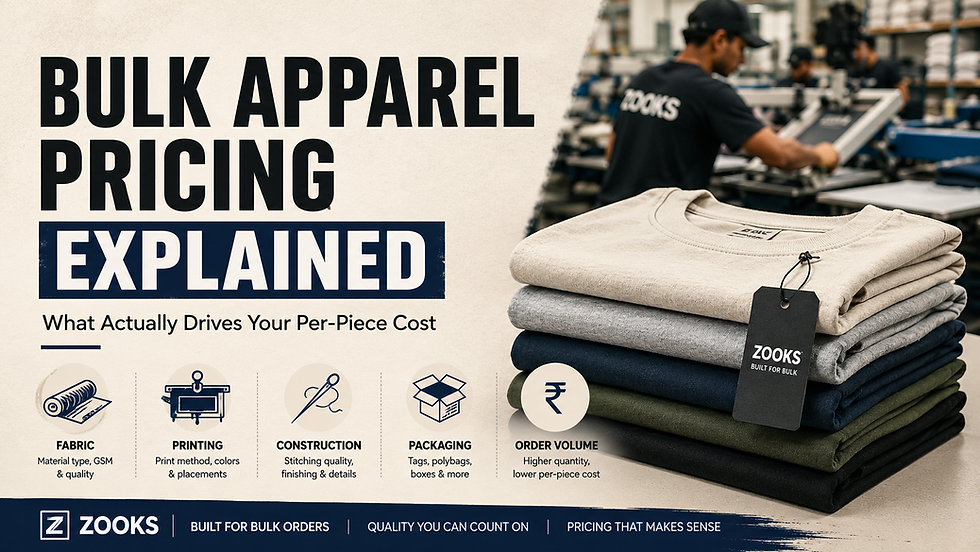
If you've ever sent the same t-shirt design to three different bulk apparel manufacturers and gotten back three wildly different quotes, you already know the problem. One vendor says ₹180 a piece. Another says ₹260. A third wants ₹340 and won't explain why. Nobody tells you what's actually inside that number, so you're stuck comparing apples to oranges and hoping the cheapest quote isn't hiding a quality cut somewhere.
It doesn't have to be a guessing game. Per-piece pricing in bulk apparel is built from a handful of concrete variables, and once you understand them, you can read any quote in about thirty seconds and know exactly where your money is going. That's what we're breaking down here.
Most of the confusion comes from the fact that two vendors can describe the exact same shirt in completely different language. One calls it "premium cotton," the other calls it "180 GSM combed cotton," and you have no way of knowing if they're even talking about the same fabric. Add in vague line items like "customization charges" or "finishing fee" with no breakdown, and it's easy to see why procurement teams, school administrators, and startup founders alike end up picking the vendor that simply sounds the most confident rather than the one offering the best actual value.
The Five Variables That Build Your Per-Piece Cost
Every legitimate bulk apparel quote, ours included, is really just five line items stacked together. Strip away the sales language and this is what's underneath.
1. Fabric: The Single Biggest Swing Factor
Fabric alone can account for 40-50% of your per-piece cost, and it's where most price gaps between vendors come from. A 160 GSM basic cotton blend and a 220 GSM bio-washed combed cotton can differ by ₹60-90 per piece before a single print or stitch happens. Polyester-cotton blends sit somewhere in between and are popular for corporate uniforms because they resist wrinkling through long shifts.
This is also where fabric selection gets misunderstood as a cosmetic choice. It isn't. The right fabric for a factory uniform that needs to survive heat and grease is a completely different spec than what you'd pick for a startup's office merch or a school's daily-wear shirt, and the price tag follows that decision, not the other way around.
There's also a quieter cost driver inside fabric that rarely shows up on a quote sheet: processing. Bio-washing, which softens the fabric and reduces shrinkage after repeated laundering, adds a small per-piece cost but pays off over the life of a uniform that gets washed weekly for two years. Pigment-dyed and garment-dyed fabrics also cost more than standard dyed yardage because the coloring happens after stitching rather than before, giving a more consistent, fade-resistant finish. None of this is visible in a quick price comparison, which is exactly why two "100% cotton" quotes can age completely differently after six months of real-world wear.
2. Decoration Method: Screen Print, DTF, Embroidery, or Sublimation
Screen printing is the most cost-effective option at higher volumes because the setup cost gets spread across more pieces, but it gets expensive fast for small runs with multiple colors. DTF (direct-to-film) has flipped a lot of small-batch pricing in the last couple of years since it doesn't need screens at all, so it's often cheaper below 100 pieces. Embroidery costs more per piece than printing in almost every scenario because it's priced by stitch count, not by ink coverage, which is why a small embroidered logo is often cheaper than a large printed design, not the reverse people expect.
Our embroidery and printing services page breaks down which method actually fits which order size, because the wrong method for your quantity is one of the easiest ways to overpay without realizing it.
3. Order Quantity and the MOQ Curve
This is the part everyone already intuitively understands but rarely sees mapped out. Per-piece cost drops as quantity rises, but not in a straight line. The biggest jump usually happens between 50 and 300 pieces, where fixed costs like setup, sampling, and screens get divided across more units. Past 1,000 pieces, the curve flattens, and the savings per additional piece get much smaller.
That's why a quote for 50 pieces and a quote for 500 pieces can look proportionally very different even on the exact same shirt. If you're a startup ordering merchandise for the first time, it's worth asking your manufacturer where the next price break sits. Sometimes ordering 20 more pieces drops your per-unit cost enough to cover the difference outright.
It's also worth knowing that quantity breaks aren't always linear across sizes. An order split heavily across S, M, L, XL, and XXL with uneven quantities per size can cost more per piece than the same total quantity concentrated in two or three sizes, simply because cutting and grading the fabric efficiently gets harder with a wider size spread. If your team's size distribution skews unusual, mentioning it upfront avoids a surprise adjustment later in the process.
4. Customization Complexity
Number of print/embroidery locations, number of colors in the design, placement (chest vs. sleeve vs. back), and whether you need individual name/number personalization all stack onto the base price. A single front-chest logo in one color is the cheapest customization tier across almost every manufacturer in the country. Add a back print, a sleeve tag, and three colors, and you've effectively tripled the decoration cost even though the garment itself hasn't changed.
If budget is tight, the easiest lever to pull isn't fabric, it's simplifying the design itself. We walk new clients through this trade-off regularly on corporate uniform orders, where a one-color embroidered logo often delivers the same brand recognition as a multi-color print for a fraction of the cost.
5. Logistics: Sampling, Lead Time, and Delivery
Rush orders cost more because they force a manufacturer to skip queue position or pull in overtime labor. Pan-India delivery to multiple branch offices in one shipment usually costs less per piece than splitting the same order into separate smaller shipments to each city. Sampling, while sometimes billed separately, is also baked into the math for first-time clients since it's effectively a small production run before the real one.
Why the Same Shirt Gets Three Different Quotes
Two manufacturers can use the exact same fabric and the exact same print method and still land ₹40-50 apart per piece. Usually it comes down to one of three things: overhead structure (in-house production versus outsourced job-work, which adds a middleman margin), batch efficiency (whether your order slots cleanly into an existing production run or forces a dedicated one), or simply margin philosophy, where some vendors price for volume and repeat business while others price each order to maximize a single sale.
This is part of why we keep production in-house rather than routing orders through third-party job-work units. It removes a layer of markup and gives more direct control over both cost and quality consistency across a batch of 500 or 5,000.
A Realistic Per-Piece Cost Breakdown Example
Take a basic round-neck cotton t-shirt with a single-color front logo, ordered at 200 pieces, as a working example. Fabric and stitching typically sits in the ₹110-140 range depending on GSM. Single-location, single-color screen printing adds roughly ₹20-30. Packaging, quality checks, and standard delivery add another ₹15-25. That puts a realistic per-piece landed cost somewhere around ₹150-200, before any markup for rush timelines or premium finishing.
Quotes meaningfully below that range for a comparable spec are worth a second look. It usually means thinner fabric than advertised, a lower GSM substitution, or corners cut on the print's wash durability. None of that shows up on a price sheet, only after the first wash cycle.
Scale that same logic up and down. A premium 220 GSM bio-washed polo with embroidered logo at 500 pieces might land closer to ₹320-400 per piece, while a basic 140 GSM promotional tee for a one-day event at 1,000 pieces could come in under ₹140. Neither number is wrong, they're just answering different questions. The mistake most buyers make is comparing a promotional-event quote against a daily-wear corporate uniform quote and concluding one vendor is simply cheaper, when really they priced two different categories of garment.
How to Read Any Quote Without Getting Played
Ask for the GSM number, not just "premium cotton." Ask whether the price is per piece all-inclusive or whether printing, packaging, and delivery are billed separately, since some quotes look cheaper purely because they're incomplete. Ask what the next quantity break is. And ask whether production happens in-house, since outsourced job-work orders tend to carry less consistent quality control across a large batch, even when the unit price looks identical on paper.
If you want a working number for your own order before committing to anything, our team will walk you through the breakdown line by line rather than handing over a flat figure with no explanation. You can request a detailed quote here and get a real cost structure back, not a sales estimate.
Common Bulk Order Scenarios and What Actually Moves the Price
• Schools and colleges: uniform programs usually run 500+ pieces across multiple sizes, so the fixed-cost spread is favorable, but multi-size logistics (small/medium/large curve planning) need to be priced in upfront to avoid mid-order surprises.
• Corporate teams: smaller batches (50-150) with higher customization complexity, since logos often need precise color matching to brand guidelines, which pushes cost up even at modest volumes.
• NGOs and event organizers: tight timelines plus tight budgets, where the smartest cost lever is usually simplifying the design rather than cutting fabric quality, since event shirts need to survive one wear, not 200.
• Private label and startup merchandise orders: smaller initial runs to test the market, where DTF or smaller-batch screen printing usually beats embroidery on cost per piece.
The Bottom Line
Bulk apparel pricing isn't arbitrary, even when it feels that way staring at three mismatched quotes. Fabric, decoration method, quantity, design complexity, and logistics are the entire equation. Once you can name which of those five is driving a quote up or down, you stop comparing numbers blind and start comparing actual specifications, which is the only way to know if ₹180 is a genuinely better deal than ₹260, or just a worse shirt.
Zooks has been manufacturing bulk apparel out of Agra, Uttar Pradesh for corporates, schools, startups, NGOs, sports clubs, and event organizers across India, with screen printing, DTF, embroidery, and private label manufacturing all handled in-house. If you want a transparent, line-by-line breakdown for your next order, get in touch with our team, or browse the full product range to see what fits your budget and quantity before requesting a quote.
Frequently Asked Questions
What is a realistic per-piece price for a basic bulk t-shirt in India?
For a standard cotton round-neck t-shirt with one-color, single-location printing at 200+ pieces, expect roughly ₹150-200 per piece all-inclusive. Premium fabric, multi-color prints, or embroidery push that higher.
Why do bulk apparel quotes vary so much between manufacturers?
Mostly fabric GSM, whether production is in-house or outsourced job-work, and whether the quote includes printing, packaging, and delivery or bills them separately.
Does ordering more pieces always lower the per-piece price?
Up to a point. The steepest savings happen between roughly 50 and 300 pieces. Past 1,000 pieces, the per-piece savings from adding more units get much smaller.
Is screen printing or DTF cheaper for small bulk orders?
DTF is usually cheaper below 100 pieces since it skips screen setup costs. Screen printing becomes more cost-effective as quantity rises past that point.
Get a Free Quote from Zooks
🌐 zooks.in | 📞 +91 79063 40279 | 📩 zooksteam@gmail.com
WhatsApp us today and get a quote within 24 hour
— The Zooks Team
WhatsApp us today and get a quote within 24 hour
www.zooks.in | zooksteam@gmail.com | Custom Bulk Apparel Manufacturer, Agra, India


